Asia-Pacific Markets · Hong Kong
Reclaimed 紅磚皮 for Hong Kong shops and 唐樓 renovations
Hong Kong buyers often search for 紅磚皮 or 古紅磚切片 when the design calls for a genuine old brick surface rather than a printed panel. For a café counter, upstairs shop or 唐樓/商舖翻新, the decisive questions are wall loading, corner continuity, carton carrying distance and how quickly the pallets can clear into a tight urban receiving window.
Port and transit
Hong Kong Port · confirm truck delivery, lift access and unloading hours
Selected South China sea or cross-border truck routings can be budgeted at about 3–5 days port/warehouse to Hong Kong after export release, subject to the confirmed consolidation cut-off, customs handling and receiving slot. Treat this as a planning range, not a guaranteed arrival promise.
Standard bulk orders start at 50 m². Selected Asia-Pacific routes accept LCL orders from 30 m², subject to batch and sailing confirmation.
Import duties and documents
Hong Kong is generally a free port and ordinarily does not charge customs duty on clay brick slips. Keep the invoice, packing list, product description and origin statement consistent, and confirm any licensing or declaration requirement with the Hong Kong broker before shipment.
Local costs and installation
For 30 m² of ordered flats allow 60 cartons and plan two export pallets. Ask the local carrier to price tail-lift truck delivery, goods-lift waiting time, stair carry by floor and carton, and removal or disposal of pallets separately.
Thin-profile slips reduce depth compared with full brick, but the designer still needs the complete dead load: dry slips, adhesive, pointing, backing board and any render or waterproofing. On old 唐樓 walls, check hollow render, moisture, movement and the capacity of the existing substrate before fixing.
Write the specification in Hong Kong terms
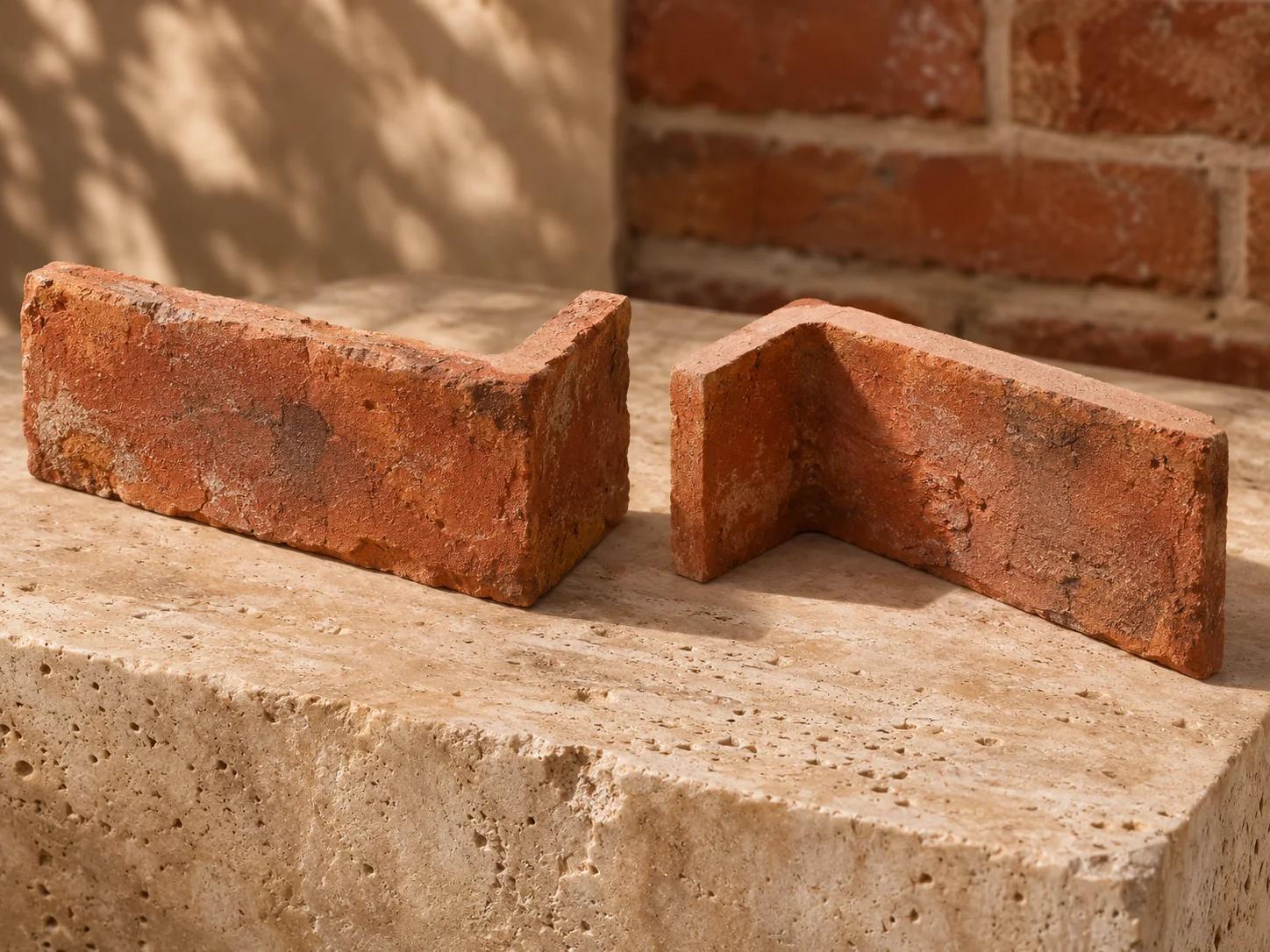
Use 紅磚皮 when discussing the thin reclaimed face, 古紅磚切片 for genuine slices cut from old red brick and 唐樓/商舖翻新 when describing the renovation context. If the design requires corner continuity, specify Heritage Red Corner rather than asking the installer to mitre every edge. In the English schedule, keep the industry term beside the SKU so a contractor, supplier and designer are pricing the same material rather than mixing it with lightweight faux brick wallpaper or concrete veneer.
Check thin-profile weight and wall loading early
A 17 kg carton covers 0.5 m², which is a logistics figure of about 34 kg per packed square metre before pallets. It is not the final installed wall load. Ask the project designer or engineer to verify the dry slip weight plus adhesive, mortar joints, backing board, render and fixings against the existing wall or stud system. This matters in older 唐樓 partitions, shopfront bulkheads and upper-floor commercial spaces where deflection or weak render can control the detail.
Plan compact deliveries for urban access
The material may arrive quickly, but the last 200 metres usually decide the cost. Measure the loading bay, goods lift, door widths, stair turns and carrying route before confirming two pallets. Ask whether cartons must be hand-carried upstairs, whether evening delivery is required and who removes empty pallets. For a small 商舖翻新, splitting the two pallets by colour lot or floor can reduce congestion, but every split should be written into the delivery quote.
Detail moisture and air-conditioning transitions
Hong Kong entrances move between humid outdoor air and cold interior air conditioning. Mark splash zones, condensation-prone columns and wet cleaning areas on the elevation. The adhesive supplier should receive the substrate, slip thickness, batch absorption and exposure before recommending a system. Trial pointing, cleaning and any breathable sealer on spare faces; dense cleaning or the wrong sealer can change the colour of a genuine 古紅磚切片 surface.
Use fast transit without compressing approval time
A 3–5 day short routing is useful only after the sample, cutting tolerance, batch range and documents are approved. Hold a signed light-to-dark reference panel and reserve the batch before booking the consolidation slot. Standard production readiness is normally 3–7 days after approval. If a shop opening date is fixed, keep one week of contingency for cartons that need to be resorted, a lift booking change or a missing signature on the delivery paperwork.
30 m² LCL indicative budget breakdown
| Material FOB estimate | Loose reclaimed red or grey brick slips: about US$420–720 for 30 m² at the indicative FOB China range of US$14–24/m². Mesh-mounted sheets: about US$660–1,020 for 30 m² at US$22–34/m². L-shaped corner returns are budgeted separately at US$18–28 per linear metre. Indicative FOB China — for project budgeting; confirm the batch quote. |
|---|---|
| Export cartons and palletising | A 30 m² flat-slip order starts at 60 half-square-metre cartons. Plan two export pallets at the 48-carton pallet planning allowance, with carton weight around 960–1,080 kg before pallet timber, corner cartons, straps and protective packing. Export cartons are palletised on ISPM-15 treated timber. |
| Indicative short-sea LCL freight | Indicative short-sea or cross-border LCL/truck budgeting range into Hong Kong: US$240–460 for the line-haul/consolidation portion of a compact two-pallet shipment, excluding Hong Kong delivery, unloading, stair carry, documentation service and any local charges. Fast 3–5 day transit depends on the confirmed cut-off and receiving slot. |
| Origin certificate and customs note | Hong Kong generally does not require a preferential origin certificate for ordinary clay brick slips. Keep the Chinese origin statement, invoice, packing list and batch reference aligned, and ask the broker whether any declaration applies to the exact shipment. |
Budget rows are indicative, not a fixed quotation. Freight validity, vehicle availability, pallet dimensions and building access can change the final landed cost.
Project reference specification
Typical commercial reference configuration based on authorized Youchang installation photographs. It is not a client-named case study or a guarantee of the result on another substrate.
- Recommended space type
- Window pier, café column, counter end or narrow shopfront return
- Flat + corner SKU pairing
- YC-T01 Sawn Terracotta flats with YC-C01 Heritage Red Corner returns to keep the edge continuous
- Mortar joint width
- 15 mm reference mortar joint · approximately 35 large-format slips per m² where the approved layout uses large pieces
- 30 m² reference quantity
- 60 flat cartons · 2 export pallets · approximately 960–1,080 kg carton weight before pallet tare
- 50 m² reference quantity
- 100 flat cartons · 3 export pallets · approximately 1,600–1,800 kg carton weight before pallet tare
- 80 m² reference quantity
- 160 flat cartons · 4 export pallets · approximately 2,560–2,880 kg carton weight before pallet tare
- Factory cutting tolerance
- Factory cutting tolerance ±3 mm; confirm final dimensions against the reserved batch
- Production readiness
- Standard production readiness is 3–7 days after sample and batch approval
Recommended products
Related buyer guides
Buyer questions
Is 紅磚皮 the same as faux brick wallpaper?
No. In this catalogue it refers to thin slices cut from reclaimed clay brick. Compare the cut edge, body colour and one-piece corner return before accepting a substitute.
Can a 30 m² order serve a small 商舖翻新?
Yes, selected LCL routes start at 30 m². Measure cutting waste and corner returns separately, then confirm cartons, pallet count and the exact delivery access.
How fast can material reach Hong Kong?
Fast sea or truck routings can be planned at about 3–5 days after export release, but the confirmed cut-off, customs handling and receiving appointment control the real date.
Do I need a structural check for thin brick?
The slip is thin, not weightless. Ask the designer to verify the complete installed load and substrate stiffness, especially on old 唐樓 walls or framed shopfronts.
Can cartons be carried upstairs without a goods lift?
Yes, but price it deliberately. Give the carrier the number of cartons, stair turns, floor count and time window so the hand-carry charge is not discovered on arrival.